The Sloth Club celebrates 15th anniversary
The Sloth Club, a Japanese environmental NGO, has been promoting the concept of “Slow” as a prescription against the ever accelerating “Fast” world for 15 years.
Over this 15-year period, the Sloth developed relationships with leaders of various movements in the world, and it is worthwhile to hear what these friends of Sloth had to say on this celebratory moment. Their words are not just “congratulations” to the Sloth but messages to all of us trying to build a better world.
●Satish Kumar (Founder of the Schumacher College)

“The vision and ideal behind the Sloth Club is of great relevance to our time when speed is the curse of modern life and has become the obsession of industrial societies. As a result of this obsession our quality of life is diminished, in order to live with joy, we need to slow down…slow work, slow food, slow architecture, slow learning and slow living should be the ideal. Slow is truly beautiful and I congratulate the Sloth Club for flying the flag of slowness.”
●Helena Norberg-Hodge (Leading figure in the localization movement)
 “I am honored and thrilled to be asked to send a message of support for your wonderful work.
To me the shift we need to make is fundamentally about slowing down and scaling down, or what I call ‘going Local’.
It is so important to hold a clear vision of the world we want, and to present practical examples to demonstrate how vital both human scale and human pace are for our own personal well being and the well being of the planet. And the Sloth Club has been doing just that in such a positive and heartwarming way over all these years.”
●Sulak Sivaraksa (Leader in Engaged Buddhism Movement)

“In spirit we celebrate together with you our shared journey of exploration, practice and commitment to a more simple and happy way of life, together with a vast web of communities of good friends across the globe.
Through your spirit of curiosity, we have shared and learnt together during your visits to Siam over the years; exploring diverse indigenous and intentional approaches and models of sustainable living, alongside inner exploration, developing critical self-awareness and compassion as the foundation for bringing alive ….
We hope we can continue this dialogue and shared journey of learning into the future. Keep on planting and growing!”
●Severn Suzuki (Renowned Canadian environmental activist)
Vandana Shiva in “Embracing the Seed of Life”
“Embracing the Seed of Life”, a new DVD from the Sloth Club is now available. This is a fourth in the “Wisdom of Asia” series, which was started in 2009 led by a cultural Anthropologist Shinichi Tsuji and a great ecological mind of the present time, Satish Kumar. Vandana Shiva, a scientist, an environmental activist, and a first woman to appear in the series, shares her thoughts with us.
Travel with Vandana Shiva in India, from New Delhi to her hometown of Dehradun, visit with her the Navdanya Farm where people gather to learn, and listen to what she has to say about “TPP”, “Genetically Modified Organisms”, and “Future of Seeds”. Also, learn about “free economy” guided by the Indian traditional cosmology, and perhaps ask yourself, “what is the joy of life?”
Vandana Shiva who has always been with farmers shows us where hope for humanity may be found.
English version is also available. Please contact the Sloth Club at info@sltoh.gr.jp for more information.
Candle Night message 2014, from Anja Light

My dear Sloth family,
It’s solstice -it’s candlelight and I’m thinking of you all!
Though it should be the depth of winter for us, here in Australia it is a very warm day with a clear blue sky -the kids have already been out in the surf – so beautiful.
Yet we carry the sense that things are out of balance….In the chaos of this climate meltdown, this nuclear madness, these unprecedented extinctions, this political nightmare, we try to reach our core, the peace, the stillness – to help us move.
Thank-you for spreading the joy, the kindness, the gentle, slow, loving way. Even if our efforts are futile – being alive like this, in this moment…could it be enough?
Sending love and hope on Candlenight…
Anja Light
slow small simple
Please join the Million Mothers against no nukes!
An Urgent Message from The Million Mothers
http://bit.ly/1lXItp8
Dear people of the world, please lend us a hand.
Right now, our Japanese government is rushing to restart 10 of the idled nuclear power reactors by summertime.
It has been 3 years since the Daiichi Nuclear plant meltdown in Fukushima. Since that meltdown, all of the 54 existing nuclear power plants in Japan have been shut down. During those three years, we have carried on. We have found enough electricity from other sources. We have proved to the world, and to ourselves, that we have do not need to take the huge risk of nuclear power, an energy sustained at the cost of many lives – from its beginnings in unsafe uranium mining to consequences at the nuclear plant operation.
3 years have passed since 3.11, but the disaster is still far from over.
Residents of the Fukushima area, including children and workers at the nuclear plant, are still being exposed to radiation.
The global standard for maximum permissible annual radiation exposure is 1 mSv (milli-sievert). However, after the nuclear disaster in Fukushima, the Japanese government raised the annual radiation exposure limit to 20 mSv. This applies even to pregnant women and infants.
Now children in and around Fukushima are beginning to show health abnormalities. Paediatric thyroid cancer is being found, with an incidence of 100 times higher than normal. Other cancers and many health problems are being reported. But our government just keeps saying these are “unrelated to radiation”. How can they say such a thing? The cancer numbers today are 5 times worse than the Chernobyl nuclear catastrophe in the 1980s.
Why doesn’t our government protect the health of its citizens by letting residents of seriously contaminated areas evacuate or bringing the radiation exposure limit back to 1 mSv/year?
The biggest reason is money. The government is unwilling to pay for evacuation or compensation.
Contamination continues to spread out, and the problem is not just contained within Fukushima or Japan. An immeasurable amount of contaminated water is leaking into the groundwater and the ocean.
This disaster is also not limited to those alive today: nuclear waste produced will last over 100 000 years! How can one generation alone decide to burden all the future with a poisonous legacy?
Dear people of the world, please lend us a hand with this.

To protect lives, to protect children, we cannot restart the idled nuclear plants.
We cannot protect our children, or our lives, without a world-wide appeal. To protect the future, we have stood up as the Million Mothers. We invite you to join us. Help us to build a global movement.
From wherever you are, please raise your voice against the restarting of the nuclear plants in Japan. Please appeal to the Japanese government to bring the annual radiation exposure limit back to the international standard of 1 mSv. Please tell our government that for the sake of the world, we cannot restart the nuclear power plants in Japan, a place with such a high number of earthquakes.
Dear people in the world, please, lend us a hand.
The Million Mothers
*”The Million Mothers” is a network of people, of all age and gender, who share a “motherly concern” to protect and treasure the lives of children.
Anyone is welcome to join us.
★Join the petition! http://bit.ly/1lXItp8
Send us the solidarity photo! info@sloth.gr.jp

I’m not exactly sure to remember what was the first movie about environmental issues I watched, but what I’m sure is that it was, with the reading of books about degrowth, a turning point in my life.
Maybe it was “an inconvenient truth”, a movie about former United States Vice President Al Gore’s campaign to educate citizens about global warming via a comprehensive slide show. Global warming was for me, as for a lot of people, THE problem our planet is facing, because it’s the most advertised… Let’s solve global warming and everything will be OK ! But….
But then, I got interested in that kind of movies, and started to watch many others. So I understood that global warming is not the only problem, and not more important than others. Actually all the problems are linked, and can’t be treated separatly, it’s a whole thing, kind of generalized cancer of earth, where humans are the cancer cells…
If I look around me, most of my friends don’t know anything about that problems, maybe heard of global warming problem, but not very in detail, with green washing advertisement or other, so not much caring about it. So that’s where I think movies developing ecological consciousness can play an important role, because before people will change, people have to be conscious that they are living in a system bad for earth and therefore themselves…it’s becoming more and more a question of survival !
So that’s why I decided to share with you the movies on ecology I watched, and what I thought about it, so maybe YOU may decide to watch it too :). Here it is :
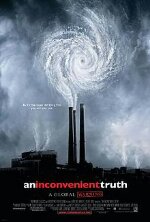
An Inconvenient Truth, Dir. David Guggenheim, 2006, 100mn
Maybe the first movie I watched, mostly about global warming, a good start but only focused on that point, you should go for something else after this one.

Manufactured landscapes, Jennifer Baichwal. 2006, 80mn
An artistic view of the changes in the landscape due to industrialization and externalisation, mainly in China, the most industrialized place in the world. It’s interesting to see the dark side of industrialization, the side most rich country consumers never see…You’ll maybe pay more attention when it’s written Made in China on a product after watching this movie !

The end of the line, Rupert Murray, 2009, 85mn
Nowadays fishing is very far from the ancient practice that started about 40,000 years ago. Nowadays fishing is obviously not sustainable…already some species already disappeared. If we continue in the same direction, species will continue to disappear till there is no fish to fish…
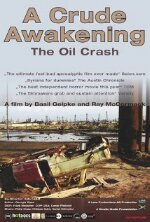
A crude awakening, Basil Gelpke, Raymond McCormack, 2006, 84mn
I found this movie about oil society a bit boring, but it’s interesting to understand that our society is based on oil, everything is possible today because of oil, a nearly free and so powerful and concentrated energy. The fact I remember the most from that movie is that 1 barrel of oil refined, is equivalent to the work of 12 people during 1 year and will cost you something like 100 USD. Can you find somebody you can pay less 4 dollar per month in the world ??…
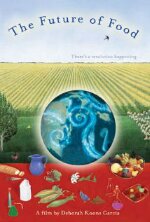
The future of food, Deborah Koons, 2004, 88mn
You think the food you buy in supermarket is safe ?…not exactly ! And do you think the food you’ll eat in the future will be safer ? It’s not really sure ! Food, with water, is base of life. Most of people in developed countries tend to forget it because it’s not really a problem for them, they have enough to eat…
But what we eat is important, it’s something we put in our bodies…and even you plate is full, it’s also maybe full of poison !

Food Inc, Robert Kenner, 2008, 94mn
Another movie about food, especially the industrial food produced in US. It may discourage you to buy your food in the supermarket or to eat in fast foods…
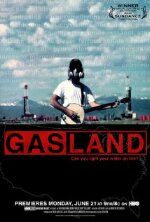
Gasland, Josh Fox, 2010, 107mn
A movie very specialized on shale gas extraction, using the “fracking process”, the only method known so far to extract that gas. So you can see how some companies were allowed to extract that gas, and all the impact of that
extraction on environment and on the people living around… Seems that French government didn’t see that movie because they are still putting the are still considering to do the same… What can people do to get cheap fossil energy, that’s crazy ! Cheap energy became a drug to our society, and a very addictive drug !
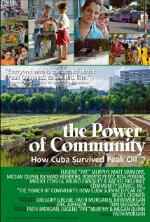
The Power of Community: How Cuba Survived Peak Oil, Faith Morgan, 2006, 53mn
I loved that movie because it’s brings hope. It’s a real example, at a country scale, of how a society can change to live without oil. How they did that ? Mainly by developing local organic farming, education and healthcare ! And the result is that Cubans live as long as Americans, consuming less than 1/8th of energy than people in US. So you see, don’t be pessimist, it’s possible !
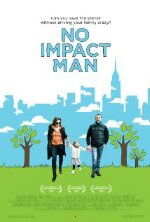
No Impact Man: The Documentary, Laura Gabbert, Justin Schein, 2009, 93mn
An American guy from Manhattan, and his wife and daughter, are trying to experience a year with the minimum impact on environment. A portrait of somebody getting conscious and starting to try the change. What will be easy to do without, what will be difficult, which benefit they will get from this year experiment…you’ll see if you watch it.
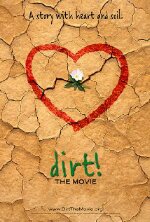
Dirt! The movie, Bill Benenson, 2009, 86mn
When I saw the title I laughed. What’s that movie, how can they make 86mn on dirt, dirt is just ground, nothing more…But I decided to watch it, and it was worth it ! Also with the french movie “Solutions locales pour un désordre global” I understood that soil is so important, because everything is coming from soil : your food, your clothes, and finally YOU ! But nowadays we cover the soil with concrete or we exhaust the soil till unfertile… Concrete, is it a nice environment for life ? I don’t think so ! Let’s cherish the soil too and humans will live better !

Tapped, Stephanie Soechtig, Jason Lindsey, 2009, 72mn
If you are in Japan, there is a big chance you are sitting less than 50m from a vending machine, and there is also a big chance that you will buy a bottle of water or tea (that is mainly water) from this machine today. Then you think it’s ok because there is a bin for plastic and your bottle will be recycled… Actually when you do that action you have a big impact. This movie is about the bottled water industry, explaining you how the industry can waste fossil fuel and trash the environment to make some money. It’s very easy, get normal water somewhere, put it in plastic bottles made from oil, and sell it very expensive to you with a nice packaging and advertising. Here it is, you have the most useless and wasting chain, just need to convince you that it’s good for you and convenient, then you buy it and they get your money. But the good news is that there is a solution, use your own bottle and fill it with tap water…nothing more simple than that !
The next titles are documentaries.
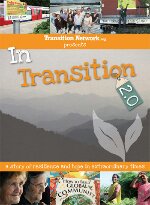
In transition 1.0, Transition culture, 2010 and in transition 2.0, Transition culture, 2012
Documentaries about the “transition movement”. If you never heard about that, it’s worth to watch these docu to understand what is it. To make it short, if you are now conscious of all these big issues and want yo do something for the change, and more than just change yourself, it’s perfectly what you need. It’s something you can start anytime, anywhere, without any money or political power, to change your community. Let’s do it !
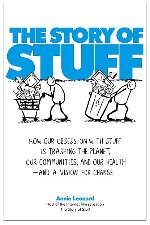
The story of…, Annie Leonard
You want to understand by drawings and easily how we trash the planet by different means ? This is for you and it free to watch it on the “The story of stuff” website.
Hope my article will bring some people to consciousness… at least 1 person and I’ll be happy 🙂
Cyclesam
 Slow Japan
